
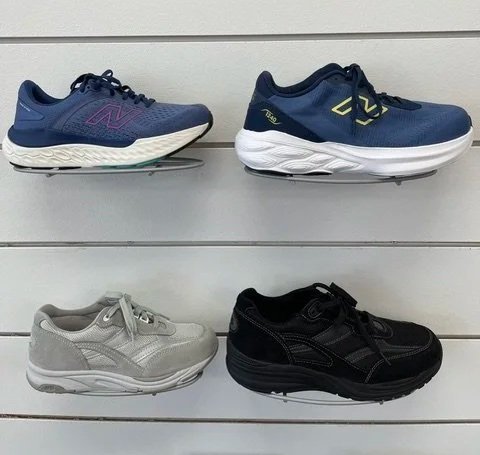
Men’s walking shoe upper left & Men’s running upper right
Women’s walking shoe lower left & Women’s running low right
What is the difference between running shoes and walking shoes? FUNCTION! We have customers who come into our store daily with foot issues such as plantar fasciitis or achielle’s tendon issues. In evaluating the activity they are doing we ask “does the shoe fit the function?” I find people countless times wearing the wrong type of shoe for the function they are performing. The running shoe market promotes “running shoes” that are designed for running, which is a different use than say standing on concrete floors all day at your job. As a clinician I help educate my clients on choosing the right type of shoe for their activity level.
Below is a concise look at the difference between a running and walking shoe from a clinical and/or biomechanical perspective.
Running shoes vs. walking shoes
Purpose and design
Running shoes: Built for higher-impact, repetitive forward motion with greater shock absorption, energy return, and often lighter weight. Designed to handle faster cadence, longer strides, and greater forces at footstrike.
Walking shoes: Optimized for low-impact, lower-cadence movement with more flexibility in the forefoot, stable heel-to-toe transition, and often more durable outsoles for everyday wear.
Cushioning and midsole
Running: Thicker, more responsive midsoles using foams or proprietary materials to absorb impact and provide rebound. Cushioning is often concentrated in the heel and forefoot depending on running style.
Walking: Moderate cushioning focused on comfort and stability rather than maximum shock absorption. Midsole tends to be firmer and more flexible to support the roll-through of the foot.
Heel-to-toe drop (offset)
Running: Often higher heel-to-toe drops (8–12 mm common) for added heel cushioning and to promote forward motion, though low-drop and zero-drop running shoes are also popular.
Walking: Typically lower to moderate drops (4–8 mm common) to support a natural heel-to-toe gait and smoother transition.
Flexibility and sole design
Running: Stiffer in some areas (to stabilize during propulsion) and designed with flex grooves or rocker shapes that aid a quick toe-off. Outsoles often use lightweight materials and focused rubber in high-wear zones.
Walking: More flexible in the forefoot to accommodate natural toe-off during a slower, flatter stride. Outsole patterns emphasize traction and durability for varied surfaces.
Support and stability
Running: Support features target dynamic motion control—stability posts, medial guides, or structured uppers—to correct overpronation at higher speeds.
Walking: Support emphasizes consistent stability and comfort for prolonged wear—wider base, firmer midsoles, and more supportive uppers for everyday activities.
Upper construction
Running: Breathable, lightweight uppers with strategic overlays for lockdown and reduced weight. May include engineered mesh or knit.
Walking: More substantial uppers that prioritize comfort, fit, and durability; can include more padding, softer linings, and traditional materials.
Weight
Running: Generally lighter to reduce fatigue and improve performance.
Walking: Can be heavier because durability and cushioning for extended periods are prioritized.
Durability and outsole wear
Running: Designed for repetitive, higher-impact miles; rubber placed in high-wear zones. Lifespan typically 300–500 miles depending on shoe and runner.
Walking: Constructed for daily use and longer wear life under different loading patterns; outsole materials may be thicker for longevity.
Fit and sizing considerations
Running: May require a thumb’s width of toe room to accommodate foot swelling during runs and ensure no toe banging. Secure heel fit to prevent slipping.
Walking: Slightly more forgiving fit for all-day comfort; can prioritize width and cushioning over tight lockdown.
When to choose which
Choose running shoes if you plan to run regularly (anywhere from short sprints to long-distance), do interval work, or need more impact protection and performance features.
Choose walking shoes if your primary activity is brisk walking, errands, standing or working long hours on your feet, or you want everyday comfort and durability.
Cross-use notes
Running shoes can be used for walking and will provide extra cushioning, but may feel less flexible or heavier for some walkers.
Walking shoes are fine for casual jogging or very light runs, but they may lack the required shock absorption and support for regular or high-intensity running.
Practical tips
Match shoe choice to main activity and foot biomechanics (pronation, arch height).
Replace running shoes around 300–500 miles; inspect walking shoes for wear and replace when comfort or support degrades.
Get a proper fit—try shoes later in the day when feet are slightly swollen, wear the socks you’ll use for the activity, and test a short walk or run in-store if possible.
These tips showcase the difference between running and walking shoes. For instance, I had a client named Jim who works at a large industrial plant. He spends up to 12 hour shifts on concrete floors and walks over 10,000 steps a shift with light heavy lifting. He scheduled an appointment because of dealing with chronic plantar fasciitis. He is a large fellow and was wearing a very popular running shoe in which he said felt like “marshmellows” and so comfortable—- at first. Over time, he said he started feeling pain in his heels- typical of plantar fascia being inflamed. In looking at his stance (due to weight and height) and his “marshmellow running shoe” I noted he supinated or his foot turned out not allowing him to be carry his body upright and become too stressful on the foot and ankle. I scanned his foot and noted lots of pressure laterally and when looking at his shoe I noted he had worn out the outsole very much with such pressure.
In my consultation, I encouraged a different shoe- a walking shoe that had much more stability, better heel counter to sustain his weight and height along with an arch support that would off load pressure on the heel and the forefoot and maintain a neutral stance inside the footwear to keep him from supination. We moved the marshmellow feel from the shoe to the insert which had memory foam so that he would still have some cushion comfort. Once the stability walking shoe was selected and the arch support Jim was amazed and found relief from some of his symptoms. It all boiled down to the right shoe and wall structure within the shoe to carry his weight, support his foot and off load pressure for the function on walking (not running) at his work place. Function matters! Shoes matter!
Now do not let that be overwhelming! At Foot Savi we help fit customers to the right shoe for their lifestyle—whether you need performance running shoes or comfort-focused walking shoes. If you’d like, bring your current shoes in and we’ll assess wear patterns and recommend the best option. We can do a scan analysis of your foot to see pressure points and evaluate your arch type. Many people do not know what their arch type is like (which is a anothe blog), yet this is so important to how the shoe functions. I tell clients all the time “your shoe is the foundation and the arch support or orthotic is the walls of your house!” You need both.